TMJ and TMD Treatment in San Antonio
You cut your food smaller, chew on one side, and brace before a yawn. The clicking stopped surprising you a long time ago, and the headaches usually arrive before the jaw pain does. That pattern has a cause, and it can be treated.
What causes TMJ and TMD?
The jaw joint works every time you eat, speak, or yawn, and it never gets to work alone. It shares muscles and nerve supply with your neck and the side of your head, which is why jaw trouble so often arrives dressed as a headache, an earache, or a toothache with nothing wrong with the tooth. Jaw pain is usually the end of a chain, not the start of one. Finding the link that started it is what makes relief hold.

Most clenching happens without permission, at a desk, in traffic, or through the night. The chewing muscles are built for short, powerful bursts, not for hours of sustained holding. Held that long they become tender, shortened, and slow to let go, and they compress the joint they cross. That is why the pain is often worst on waking, why the jaw feels tired by mid afternoon, and why a night guard can protect your teeth while doing nothing about what the muscles are actually doing.
The muscles that position your head also decide where your jaw rests and what path it travels when you open. A head that lives forward of your shoulders changes both. Long hours at a screen, a phone pinned between ear and shoulder, and a stiff upper back all quietly reshape jaw mechanics. This is why treating only the jaw tends to buy short relief, and why your neck and upper back get examined at the first visit even when neither of them hurts.
A small cartilage disc sits between the jaw and the skull and glides with the joint every time you open. When it slips forward it can catch and then snap back into position, which is the click or pop you hear. If it stops relocating, the jaw can lock partway open or refuse to open fully. Clicking on its own is common and not an emergency. Clicking with pain, catching, or a loss of opening is the point where guided treatment changes where this ends up.
A blow to the face, a whiplash from a car accident, or a hard fall can strain the joint and the muscles wrapped around it. So can holding the mouth wide open for a long stretch, which is why symptoms sometimes start after an extraction, a crown, or oral surgery. The tissue is irritated and the muscles guard to protect it. Hands on treatment and controlled movement settle that guarding before it hardens into a lasting restriction in how far you can open.
Stress does not cause TMD by itself, but it decides how hard your muscles hold. Under pressure the jaw, neck, and shoulders brace, breathing gets shallow, and sleep gets lighter, which is when most grinding happens. Add gum through the day, nails or pens between the teeth, a chin resting in one hand, and chewing on one side only, and the joint never gets an off cycle. Removing that constant low grade load is often what lets the hands on work finally hold.
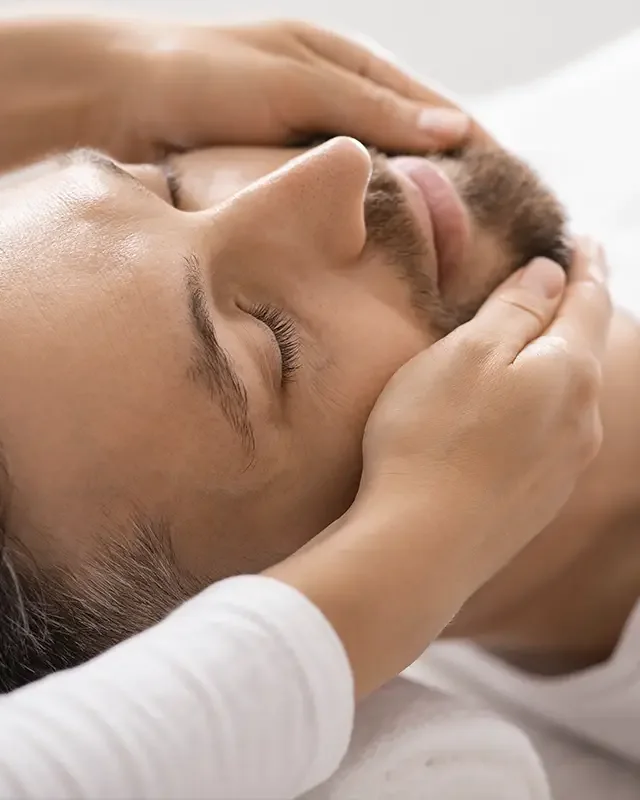
How physical therapy in San Antonio helps.
Jaw pain is treatable, and in Texas you can start without waiting on a physician. Direct access allows up to 30 days of physical therapy with no referral, so the first step is a phone call rather than an appointment to get an appointment. Your care follows the same four phases we use for every condition. Pain, where hands on work through the chewing muscles, the temples, and the neck takes load off the joint. Prime, where we restore opening, closing, and side to side motion and correct the path the jaw travels on the way. Perform, where you rebuild control for chewing, speaking, and yawning without bracing. Prevent, where you leave with a home programme, a resting position for your jaw, and the habit changes that keep it quiet. Sessions run 30 to 60 minutes, one on one, with the same therapist each visit.
What to expect from your recovery.
Evaluation and a clear cause
Your first visit measures how far your jaw opens, whether it deviates on the way, and which muscles are tender to the touch. We examine your neck and upper back in the same session, because they so often drive the jaw. You leave knowing what is producing your symptoms and what your plan looks like, not holding a generic sheet of exercises.
Calming the joint, restoring the motion
Hands on treatment releases the chewing and neck muscles holding the joint under constant load, and gentle joint work restores the glide that opening depends on. Dry needling is used when a trigger point is clearly driving the pain. Most people notice a change within the first two to three weeks, and your therapist will give you a timeline for your case at the evaluation.
Control that holds after discharge
As pain settles, the work shifts to control. We retrain the path your jaw travels, strengthen the deep neck muscles that hold your head where it belongs, and rebuild tolerance for chewing and long conversations. A typical course is two to three visits a week for four to six weeks. You finish with a home programme and the habit changes that protect the result.
A big endorsement for any health program is when doctors like and respect it enough to send referrals. My two spine docs and my primary doc are big promoters of Liberty!
Pain rarely travels alone.
Arthritis
Stiff, aching joints that limit your activities. We restore mechanics and build strength.
Knee Replacement Surgery
When major joints fail, movement suffers. We treat the source, not just the symptom.

Headaches
Tension headaches and neck-driven migraines respond to treating the neck, not the symptom.