Shoulder Pain in San Antonio
You have worked out which side to sleep on, which shelf to stop reaching for, and how to get a coat on without wincing. That is a lot of daily accommodation for a joint that usually responds well to being loaded correctly again.
What Causes Shoulder Pain?
The shoulder trades stability for reach. It is the most mobile joint you own, and it stays safe only because the rotator cuff, the shoulder blade and the mid back cooperate to keep the ball centered while the arm moves. When one of those stops doing its share, the joint produces pain in familiar places: the outside of the arm on the way up, the front of the shoulder on the way down, and the night you spend awake on the wrong side.
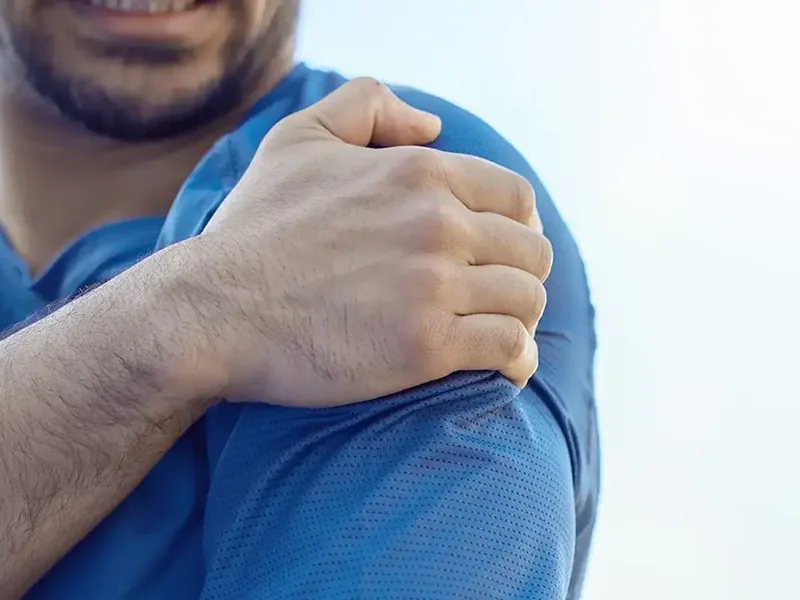
A small group of deep muscles holds the head of the arm bone centered in a shallow socket. Load them repeatedly without recovery and the tendon degenerates. Load them suddenly beyond what they can take and it tears. The signature is pain on the outside of the arm with reaching, and a night that gets worse the moment you roll onto that shoulder. Many cuff problems, including some partial tears, do well with progressive strengthening, because a stronger cuff changes how the joint moves even when the tissue itself is imperfect.
When the cuff fatigues, the head of the arm bone drifts upward and pinches the tendon and bursa against the bone above it. You feel it inside a narrow arc of overhead movement and almost nowhere else. Rest quiets it down and the first week back at work brings it straight home. Treatment restores the shoulder blade's upward rotation, strengthens the cuff so the head stays centered, and rebuilds overhead capacity until that arc stops being painful.
Adhesive capsulitis is stiffness rather than weakness. The capsule around the joint thickens and contracts, and motion is lost in a predictable order, with rotation away from the body going first. It often follows an injury, surgery or a stretch in a sling, and it turns up more often alongside diabetes and thyroid conditions. Recovery is slow and genuinely staged: settle the irritability, then work the capsule steadily, then rebuild strength through the range you have won back.
Your shoulder blade has to rotate and tilt out of the way for the arm to travel overhead. If the mid back is stiff or the muscles that steer the blade have lost endurance, the arm asks the joint for motion the joint cannot safely give, and the tissue at the top of the shoulder gets pinched for it. This is one of the most common findings in a shoulder assessment and one of the most fixable. Blade control often reduces pain before we have treated the shoulder itself.
The acromioclavicular joint sits on top of the shoulder where the collarbone meets the shoulder blade. Sprains from landing on the point of the shoulder and arthritic change both make that spot tender, with pain when you reach across your body or press overhead. Point tenderness directly on the joint is the giveaway. Loading the shoulder in positions the joint tolerates, while restoring the mechanics around it, usually settles the irritation.
Cartilage change inside the ball and socket, or wear at the labral rim that deepens it, produces stiffness, catching and a deep ache rather than a sharp arc of pain. Range narrows gradually and most people notice it first putting a hand behind their back. These joints do best with movement they tolerate and strength around them. Therapy manages irritability, keeps the available range open and builds the cuff and blade so the joint itself is doing less of the work.
How physical therapy in San Antonio helps.
Assessment sorts a shoulder into a short list of stories, and the story determines the plan. Your therapist compares what you can lift yourself against what moves when the arm is relaxed, tests each cuff muscle separately, watches how the shoulder blade travels as the arm rises, and screens the neck, because neck referral wears the disguise of shoulder pain often enough to be worth ruling out. Hands-on work gives back the range that is missing. Then the real work starts, which is loading the cuff and the shoulder blade progressively until the joint can handle what you ask of it. Visits run 30 to 60 minutes, one on one with the same therapist, typically 2 to 3 times a week for 4 to 6 weeks.
What to expect from your recovery.
Sorting out which shoulder problem you have
Your therapist compares what you can move yourself against what moves when the arm is relaxed, tests each cuff muscle in isolation, watches the shoulder blade through the full arc and screens your neck. That distinction between stiff and weak decides everything that follows. You finish the evaluation knowing what is driving the pain and what the sequence of care looks like.
Restoring the range and calming the joint
Hands-on mobilization, soft tissue work and dry needling where it is indicated give back the motion the joint is missing and take the edge off the night pain. We start loading in whatever ranges you tolerate straight away, because a shoulder that stops moving stiffens quickly. Most people notice a change within the first two to three weeks of consistent work.
Loading it until it holds
Strength is what keeps the result. We build the rotator cuff, the shoulder blade muscles and the mid back through progressively heavier work, then rehearse the specific things you stopped doing: the overhead press, the top shelf, the seat belt, the throw. You leave with a home program and a clear idea of what to keep doing so the shoulder stays capable.
Liberty Rehab did a fantastic job identifying my shoulder issue and designing a plan to get me back to pain free movement. Would highly recommend them for your physical therapy needs.
Pain rarely travels alone.
Elbow, Wrist & Hand Pain
When the shoulder is weak, the forearm and wrist absorb the work it is not doing. The chain is worth checking.
Arthritis
Arthritic change in the shoulder responds to movement it tolerates and strength around the joint, not to rest.

Sports Injuries
Overhead and throwing sports load the cuff hardest. Return to play needs measured strength, not just quiet pain.